A defense program is a working network of primes, subprimes, aggregators, specialty manufacturers, service providers, and individual suppliers. Requirements and delivery dependencies move through that network.
Your team needs to see which suppliers meet the requirements, whose information is missing or outdated, and which suppliers have a gap to close. A clear status summary helps you direct attention and support where they are needed.
A supplier’s status should be tied to the requirements it must meet for your work. The same company may serve several customers and manage suppliers of its own. Keep the basis and date of each answer available behind the summary.
Deep Fathom · Updated September 13, 2026
Build the record around decisions
For every supplier relationship, put four questions beside the award, information-sharing, or delivery decision.
What work and program does this support?
Tie the record to a delivery dependency. A machine shop making one part and a systems integrator supporting a test environment should not enter the program as interchangeable vendors.
What terms and information apply?
Record the clause or customer term, the work, and whether FCI, CUI, or another condition is involved. FAR 52.204-21 addresses safeguarding for covered contractor information systems handling FCI, subject to its terms. DFARS 252.204-7012 carries separate covered-defense-information conditions and subcontract flow-down language. A supplier label doesn’t decide either route.
What is the supplier’s current answer?
Keep the required status or declaration, its date, scope limits, and review notes together. The summary should show how the answer was established and when it was last checked. Ask for supporting material when the terms require it or the answer does not cover the work.
What decision remains open?
Name the decision, owner, and follow-up date. The record should tell a reviewer what to do next.
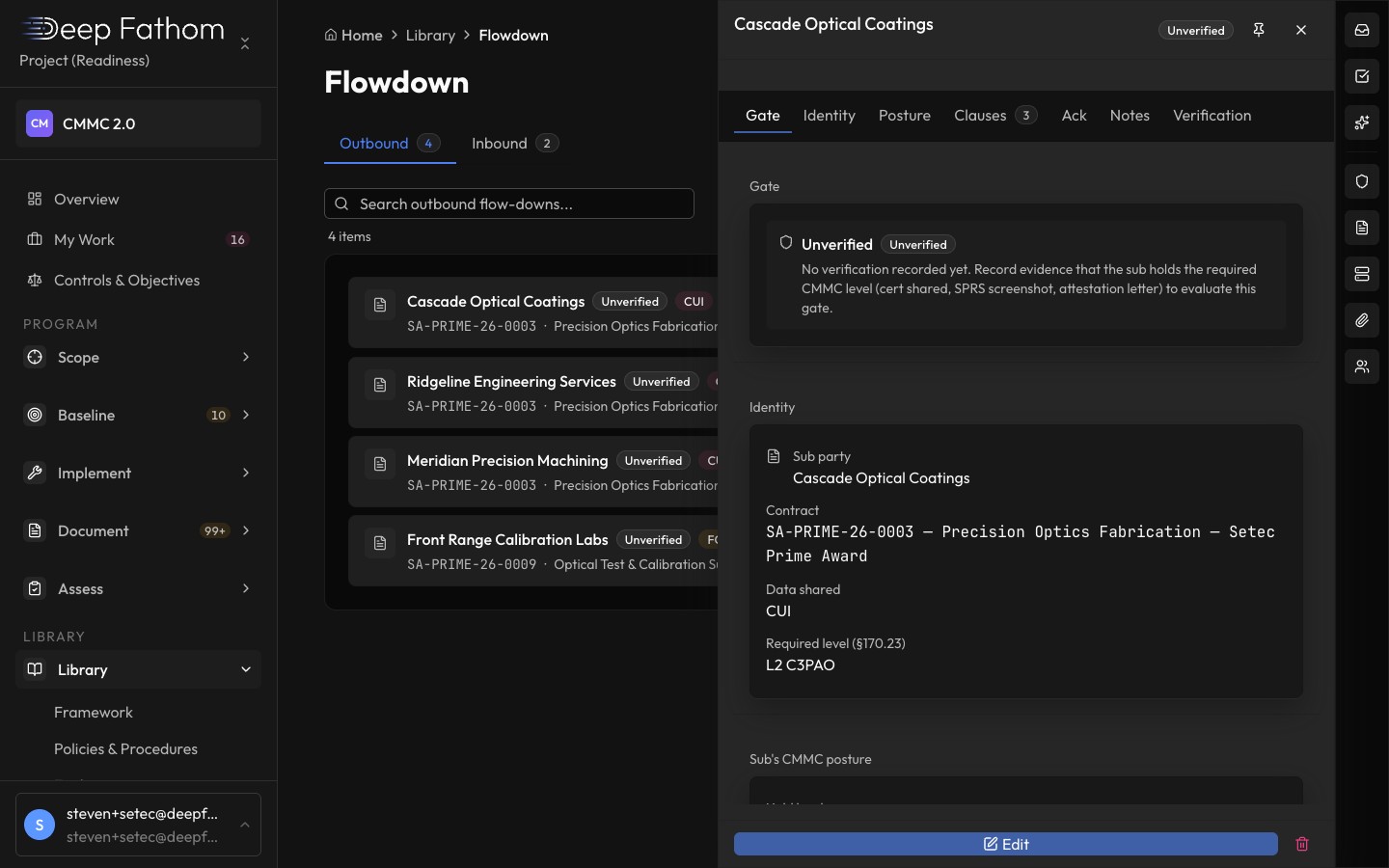
Deep Fathom’s Flowdown workflow supports that program record. For an outbound relationship, it brings together the supplier, contract, FCI or CUI context, required level, recorded status, acknowledgment, review notes, and optional linked evidence.
In Deep Fathom
See the record behind a supplier's status.
A Flowdown record connects one supplier obligation with its contract and recorded status. This is a single supplier record, with the detail available for follow-up.
Not every missing item is the same problem. Treating them alike makes follow-up slow and makes risk reporting vague.
The scope is unresolved
The team needs a contract or information-handling decision. Do not ask the supplier to invent an answer.
The supplier has not responded
The relationship owner needs a date and follow-up route.
The supplier reported a gap
The program needs an owner, plan, and checkpoint. A reported gap is different from silence.
The available record needs follow-up
The reviewer needs a defined request. That may be a scope clarification, a plan and date for a reported gap, or targeted supporting detail through an agreed route.
Flowdown records inbound agreements and outbound obligations. Suppliers can use Deep Fathom to assess gaps, assign compliance work, organize evidence, and maintain their records. A prime can recommend, coordinate, or sponsor that workflow for a defined supplier group. Agree access, reporting, and information-sharing terms for the program.
Bring one program where your team needs to know who meets the requirements, whose answer is missing or stale, and which important suppliers need help. We’ll discuss the visibility your team needs and how to help suppliers become and remain compliant.
Tell us which supplier group you need to support and the requirements it must meet. We’ll discuss how Deep Fathom can help your team track compliance status and help suppliers close gaps, through recommendation, a coordinated rollout, or sponsored access.
 Expand product view