Primes · Subprimes · Integrators · Aggregators
Give your suppliers a path to compliance and your team the visibility to manage it
Your contracts depend on suppliers that can meet the requirements for their work. You need to know which suppliers can demonstrate compliance, whose information is missing or out of date, and where a gap could affect an award or delivery.
Deep Fathom connects that oversight with a platform suppliers can use to become and remain compliant. Your team can organize supplier responses and follow-up. Suppliers get a practical way to close gaps and maintain the work behind their answers.
Start with the capability your program needs to keep
Make the supplier record useful to the buyer
A useful supplier summary answers three questions: does the supplier meet the applicable requirements, is its response current, and does anything need attention? Keep the requirement, the basis for the answer, and the relevant dates available behind that summary.
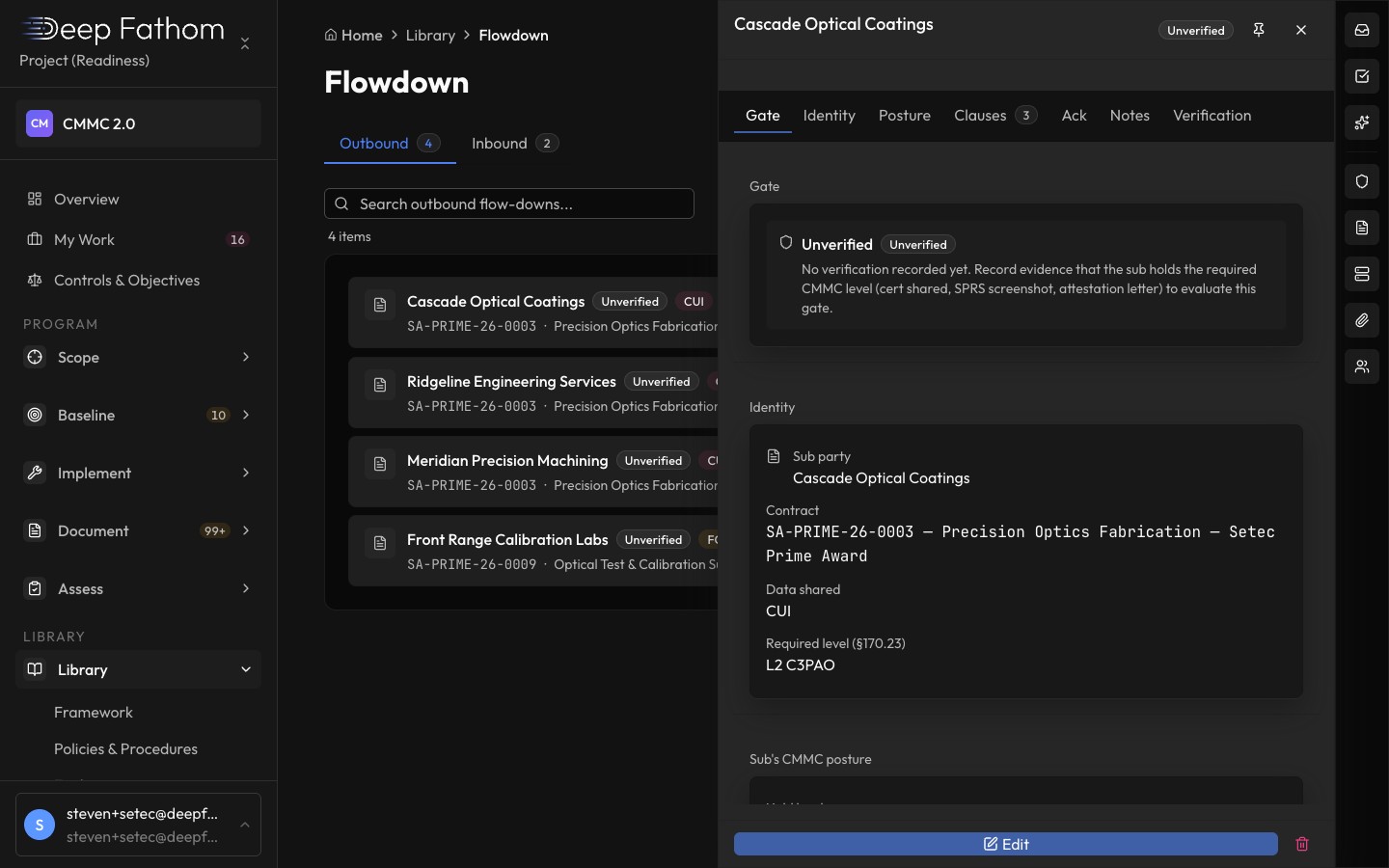
Deep Fathom’s Flowdown workflow connects the obligation, supplier acknowledgment, recorded status, and review notes. Your team can use those records to manage follow-up. Suppliers use the platform to assess gaps, assign work, and maintain supporting evidence. Agree the information each participant will provide and who can review it.
The commercial offer is broader than a record alone. A prime can recommend Deep Fathom, coordinate a defined rollout, or fund access for a supplier group. The access, reporting, and information-sharing terms belong to that program design.
Plan the visibility your team needs.
In Deep Fathom
Keep a downstream obligation in view.
Flowdown brings the contract, supplier, and recorded review status together. The required level shown belongs to this demo contract.
 Expand product view
 Extend the program through the tiers
Choose how suppliers participate
Discuss a supplier compliance program
Explore the guides
Build the program around the work.
Ask suppliers to demonstrate compliance
Ask for the compliance status and required records that apply to a supplier's work. Follow up on missing answers, outdated information, and gaps.
Read the guide Prime & buyer guideMulti-tier supplier assurance requires a chain of decisions
A prime-side method for working with subprimes and aggregators when status, exceptions, and follow-up travel through several supplier tiers.
Read the guide Prime & buyer guideSelect a supplier assurance platform for the work your team must run
A buyer guide for primes evaluating a platform to connect supplier requirements, status, exceptions, supplier work, and follow-up.
Read the guide Prime & buyer guideHelp critical suppliers meet defense requirements
Help important suppliers meet and maintain defense requirements through a recommended platform, coordinated rollout, or funded access.
Read the guide Prime & buyer guideBuild a supplier compliance program that supports delivery
Help suppliers meet defense requirements, track their compliance status, and address the gaps that could affect your program.
Read the guide Prime & buyer guideSee which suppliers meet your requirements
A practical model for primes that need a current view of supplier requirements, reported status, exceptions, and follow-up.
Read the guideWork with Deep Fathom
Discuss a supplier compliance program.
Tell us which supplier group you need to support and the requirements it must meet. We’ll discuss how Deep Fathom can help your team track compliance status and help suppliers close gaps, through recommendation, a coordinated rollout, or sponsored access.