Build from requirement to operating work
Start a requirement register that names the source and owner. For each item, record the affected work or system, current condition, needed action, expected evidence, and the date or event that will trigger review.
The register does not need to be elaborate. It needs to answer a management question: can your team show that it meets the requirement and back up that answer?
Public resources can help your team get started. The Department lists Project Spectrum training and readiness checks, including free training courses that require registration. Decide who will use that help and who will carry out the resulting work.
Then sequence the work.
- Confirm applicability. Read the contract, subcontract, amendments, and customer instructions. Identify unresolved questions before planning around an assumption.
- Set the boundary. Document the systems, information, locations, people, and service providers involved in the covered work.
- Compare current practice to the requirement. Look at how work happens today. A policy statement does not show that access is reviewed, media is handled, or incidents follow the required route.
- Assign corrective work. Give each gap an accountable owner, a practical action, and a decision date. Add outside support where your team needs it.
- Retain evidence as work occurs. Keep the record with the requirement and boundary it supports. Later reviews are easier, and stale material is easier to spot.
- Choose the required demonstration route. A customer response, self-assessment, affirmation, and authorized assessment have different purposes. Use the route in the governing terms.
In Deep Fathom
Work through a requirement in context.
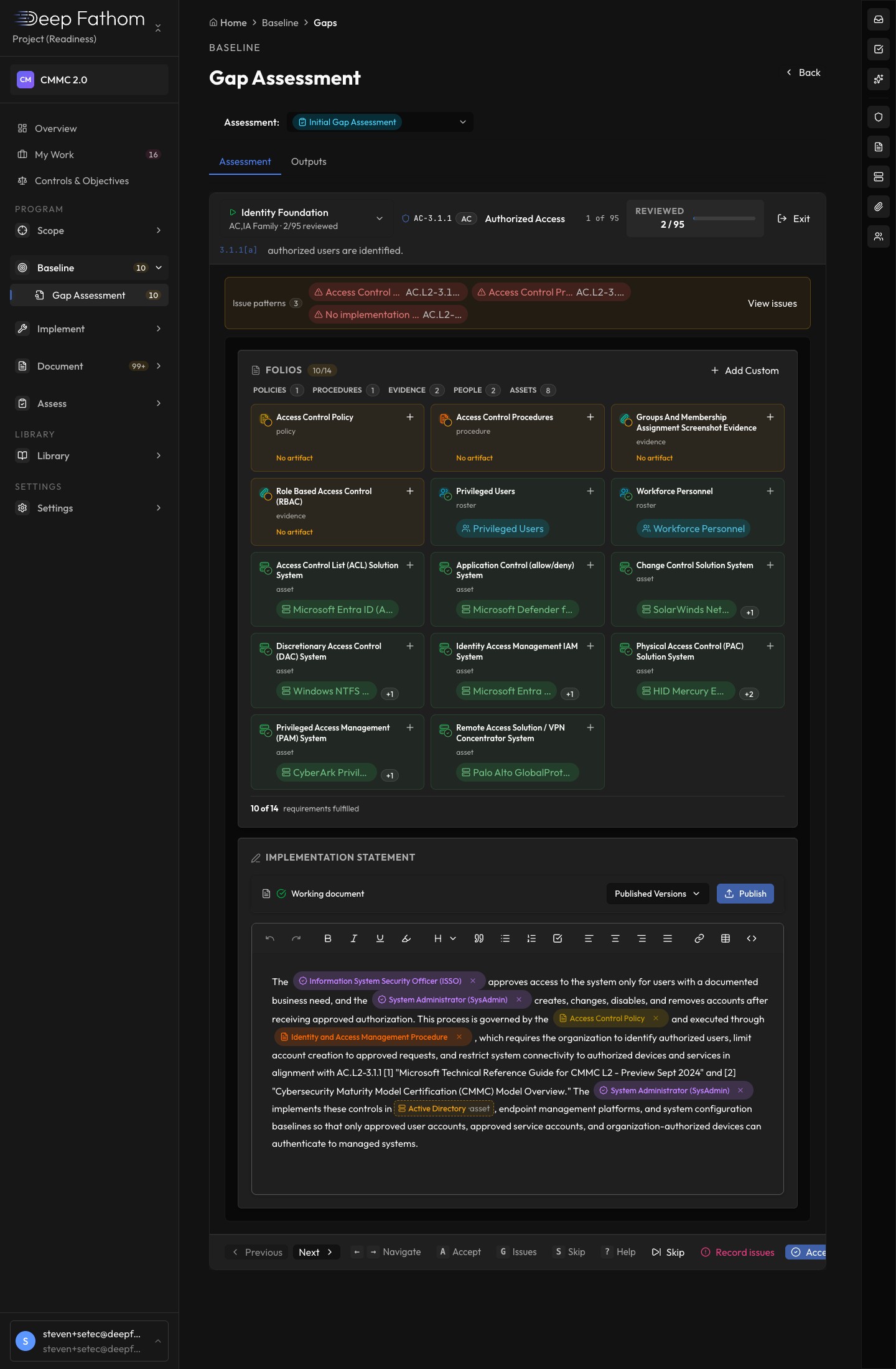
Gap Assessment brings an objective, needed records, linked artifacts, and an implementation statement into the same review workspace.
 Expand product view
 A decision aid for a common trap
Suppose a supplier has written access-control procedures and uses multifactor authentication in its corporate email system. The covered engineering environment sits elsewhere and uses a different identity process. The procedure explains intent. It does not show that the engineering environment follows the same practice.
Ask three questions. Does the evidence cover the relevant environment? Does it describe what happens today? Does it meet the response requested by the customer or assessment route? If any answer is no, create a scoped action instead of making a broad statement.
A credible supplier answer gives the upstream customer a record it can review. Uncertainty that stays hidden creates a problem upstream.
Deep Fathom connects a baseline and gap assessment to remediation, assigned tasks, policies, implementation statements, and evidence tied to the work. It gives smaller suppliers a practical place to run their compliance work and prepare a record when customers ask informed questions. It does not make an organization compliant or replace required assessments.
Bring one applicable requirement, the affected system boundary, and your next customer deadline to a platform evaluation conversation. Use the FCI and CUI questions first, then prepare to maintain the result.