For defense suppliers Practical guide

Understand the requirements attached to your defense work

In the defense industrial base, a company may be a subcontractor on one program, a prime on another, and a buyer to smaller firms on both. The chain includes primes, subprimes, aggregators, manufacturers, service providers, and specialists.

An incoming requirement is easy to misread. A customer request may name a clause, security standard, assessment status, or document they expect. Those labels do not answer the first question: what does this contract require from your company for this work?

Start with the governing agreement and current subcontract. Identify the work, systems, and information involved. Keep the question where it began. A forwarded email or generic questionnaire does not replace the terms that govern the work.

Deep Fathom Updated September 13, 2026

Separate the common defense routes

Two cyber clauses often appear in defense supply-chain conversations. They serve different purposes.

FAR 52.204-21 addresses safeguarding covered contractor information systems that process, store, or transmit Federal Contract Information. Its basic safeguarding requirements and subcontract condition have their own scope and exclusions.

DFARS 252.204-7012 addresses covered defense information and includes separate flow-down conditions. It points to security requirements for covered contractor information systems. Do not assume every defense supplier handles the same information or follows the same route.

CMMC belongs in the assessment discussion when it appears in the applicable terms. The published DFARS 252.204-7021 distinguishes Level 1 and Level 2 requirements and assessment statuses. Current implementation matters too. The Department’s July 2026 implementing instructions suspend Phase II requirements and specify how affected solicitations and contracts should be changed. Confirm the current terms and applicable amendments or modifications before your team represents a status.

Turn the requirement into a working decision

Build a short intake record before implementation begins. It should answer six questions.

  1. Name the source

    Record the contract, subcontract, clause, amendment, or customer instruction and its version. The source anchors the rest of the review.

  2. Define the work in scope

    State the program, deliverable, service, location, and lower-tier involvement. A clause becomes useful only when the covered work is clear.

  3. Describe the information

    Record FCI, covered defense information, CUI, or an open question that needs resolution. Do not use a label from an email subject line as the final answer.

  4. Identify the supporting systems

    List the people, tools, and environments in the relevant boundary. The required safeguards must match the actual work.

  5. State the requested response

    Establish what the customer needs to confirm compliance and when. Record any required assessment, affirmation, declaration, or supporting material.

  6. Assign the decision owners

    Name the internal owner and the customer contact for unresolved applicability. A record without an owner does not move the work forward.

Consider a machine shop that receives design data for a defense component through its prime. The next step is to establish the data type, systems that hold it, subcontract terms, and response the prime requests. Declaring a companywide certification level from the email subject line skips those decisions.

Deep Fathom helps suppliers connect requirements to assigned work and the evidence needed to demonstrate compliance. Bring one incoming clause or customer request, the covered work, and the information involved to a platform evaluation conversation.

Next, determine whether FCI or CUI changes the path. Return to the supplier assurance hub.

In Deep Fathom

Keep the contract context close.

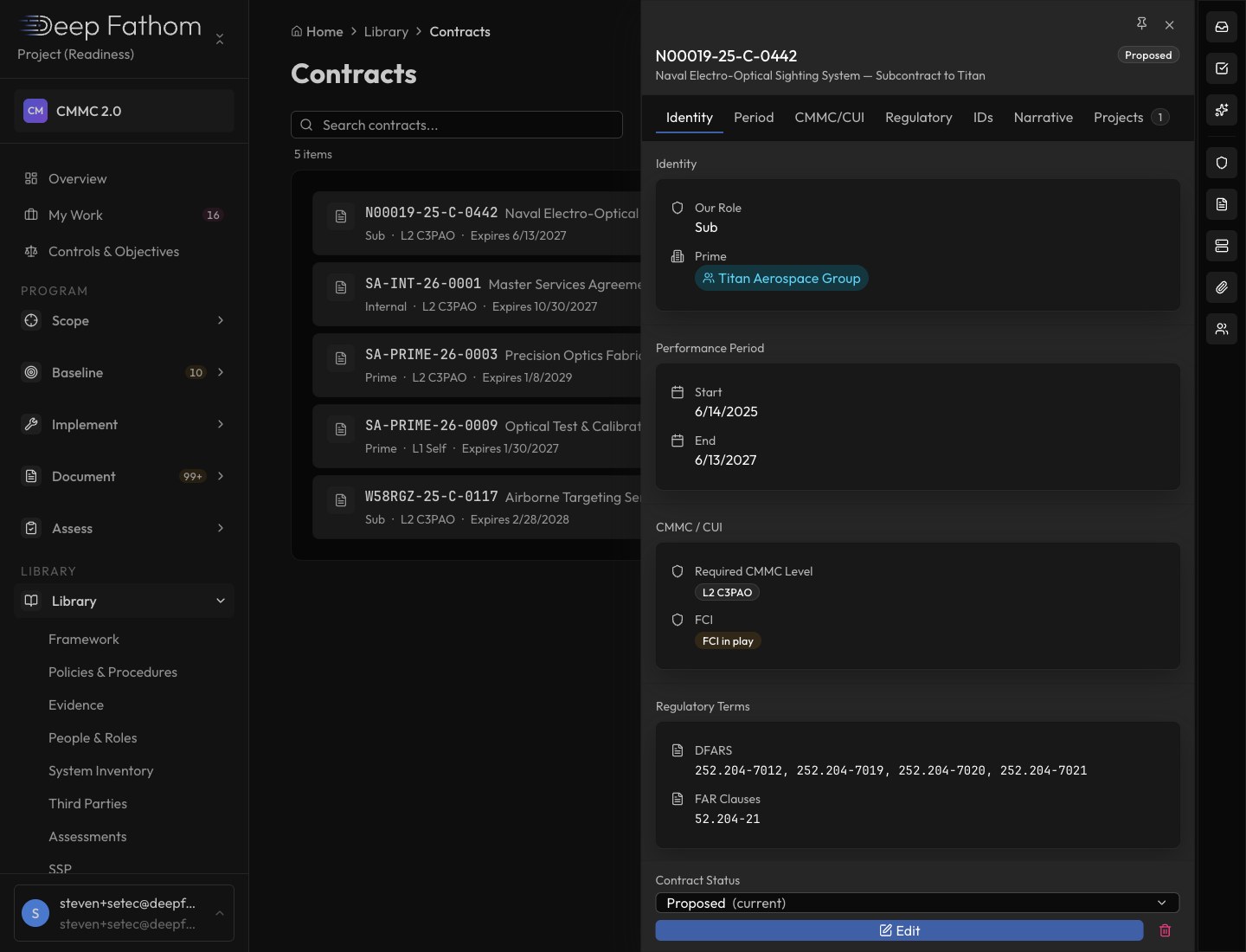
The contract record holds role, dates, information flags, and regulatory terms. Its example assessment level is specific to this contract.
Keep the contract context close. Expand product view
Product view with demo data

Keep the contract context close.

The contract record holds role, dates, information flags, and regulatory terms. Its example assessment level is specific to this contract.

Product view with demo data. Open original image

Related reading

Put the requirements into practice.

Work with Deep Fathom

See how Deep Fathom fits your work.

Tell us what defense work you are pursuing or performing, the requirement your customer has raised, and where your team needs help. Our team will discuss the relevant platform workflow and support options.