If your defense work depends on other suppliers, you have responsibilities in both directions. You may machine a component for a subprime, buy specialty processing from another shop, rely on an IT provider, or use a logistics partner for part of your contract work. In each case, you answer upstream requirements and decide what applies to your own suppliers.
Ask your suppliers to confirm that they meet the requirements for the work you send them. State the required response and who can answer questions. You still must meet the duties attached to your own contract. Sending a clause downstream does not transfer that responsibility.
Deep Fathom · Updated September 13, 2026
Flow down with context
Start with the prime contract and your subcontract. Identify the provision, its stated conditions, and the lower-tier work that creates the need for a flow-down. Tell the supplier what you need and what decision its response supports.
For example, DFARS 252.204-7012 includes a flow-down requirement under the conditions stated in the clause, including operationally critical support or performance involving covered defense information. FAR 52.204-21 has a separate subcontract condition for basic safeguarding requirements. Read the text and actual lower-tier work. Neither clause replaces an applicability decision.
Identify the requirement
Give the supplier the source and version of the requirement. It should be able to see the obligation you are applying.
Describe the covered work and information
State the relationship between the clause, work, and information. This makes the request reviewable.
Start with the assurance response
Ask whether the supplier meets the requirements for this work. Request the required assessment or declaration information, relevant dates, and any outstanding issues.
Set the follow-up route
Tell the supplier when you need the response and who resolves questions. Ask for technical detail if it is required or needed to resolve a gap or unclear answer.
Set the handling route
Tell the supplier how to respond and ask for clarification. The supplier should not share information through an unapproved channel.
In Deep Fathom
One company can buy and supply defense work.
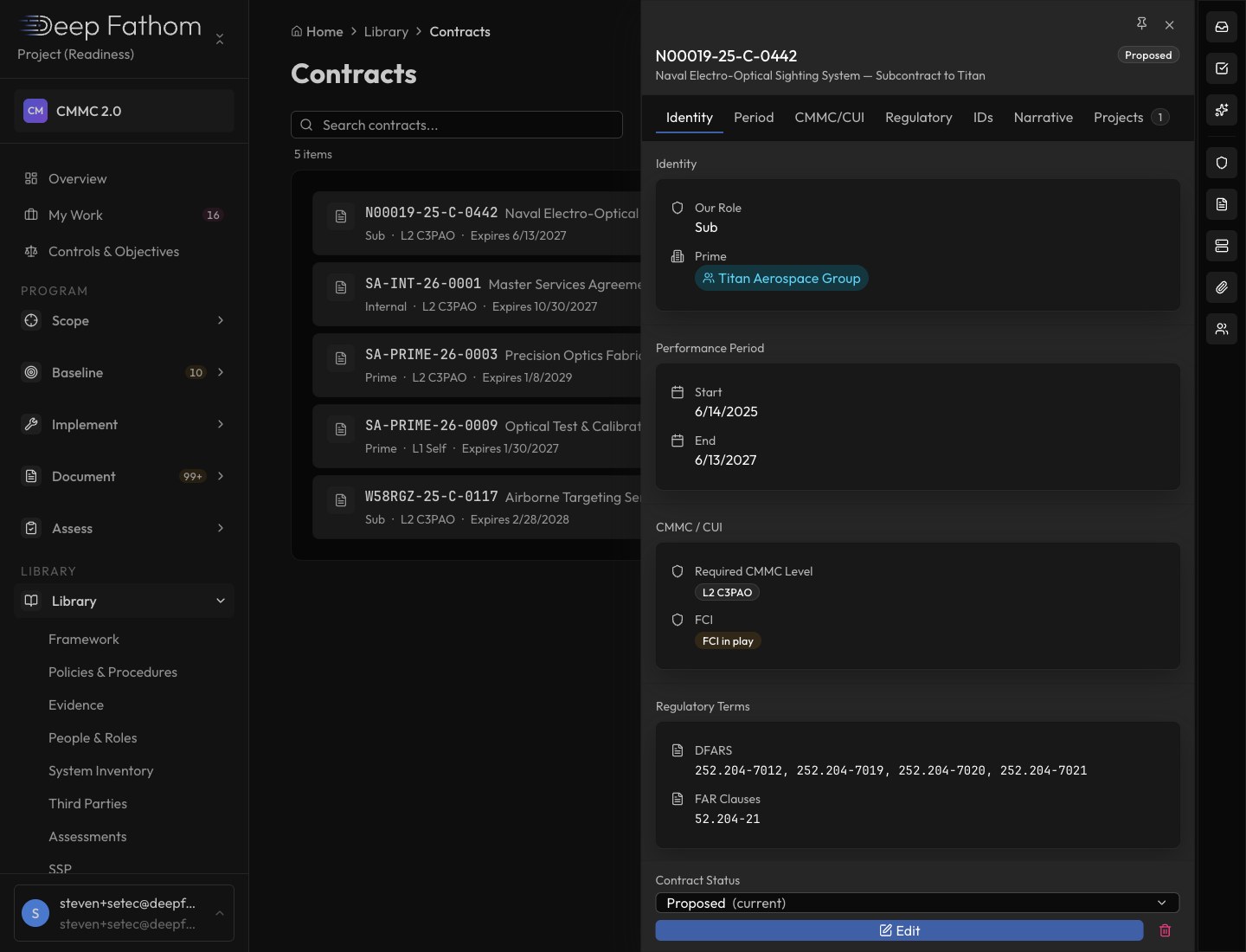
A contract record identifies the company’s role and its prime relationship. Keep the response tied to that contract and the work it covers.
Review conditions without pretending to certify the supplier
Your review can establish whether a response addresses the work you asked about. It does not create a government assessment status or erase your own duties. Where the CMMC clause applies, its published text distinguishes self, authorized third-party, and government assessment roles, along with affirmations and flow-down requirements. Read DFARS 252.204-7021.
Suppose your business sends controlled technical data to a finishing provider. Start by asking whether it meets the applicable requirement for that work and whether its answer is current. A scope gap or question about the data flow can trigger a targeted follow-up. Record the condition, assign follow-up, and keep the customer response tied to what you reviewed.
Deep Fathom supports the lifecycle in both directions. Its Flowdown workflow can record an inbound agreement from a prime or an outbound obligation to a lower-tier party, including the contract, FCI or CUI context, required level, recorded posture, acknowledgment, verification method, and linked evidence where appropriate. It gives a lower-tier buyer a structured record for supplier follow-up while giving a supplier a place to run its compliance work. The platform supports judgment. It does not delegate contract duties or certify downstream acts.
Tell us what defense work you are pursuing or performing, the requirement your customer has raised, and where your team needs help. Our team will discuss the relevant platform workflow and support options.
 Expand product view